Social interaction can be hard. We all sometimes have trouble deciding what we want to say in a given conversation. We want to react genuinely, say the “right” thing, and express our personalities candidly.
Social interaction in a different language can be even harder. Suddenly, not only does one have to read social cues to decide what to say, but he must also be able to find the words to do so in this foreign language.
The previous statements were thoughts that I had this week at dinner with my host parents. Every night, we engage in quick conversation involving the discussion of our days, the weather, or sometimes the food we’re eating. But at times, it seems difficult to do this every night. I almost feel as if we run out of subjects to talk about. Joint with the fact that my vocabulary in French is limited, simple evening dinners can be exhausting.
Well, after having had these recurring thoughts, it was evident that I needed to do research and reflection to resolve them. I started looking through a book that an old study abroad student left in my room about living in a foreign country. I learned that when communicating in a foreign language, the most important part of communication is the pronunciation. The author explains that one can manage knowing only five percent of the entire vocabulary of the language and using only 50 percent of its grammar correctly. Therefore, the most important part of the communication is the oral orthography.
In regard to the occasional silences during dinner, I came to the realization that perhaps I am looking at these dinner conversations pessimistically. I would catch myself thinking about how there seemed to be nothing to talk about. But this is not how I should be thinking! My host parents are in their sixties. They have a wealth of information to share with me if I find the right questions to ask!
Since this research and reflection, I have also noticed that when I do not focus too much on having perfect grammar while speaking French, others still typically understand me, and I am able to express my thoughts faster. In addition, not only has conversation flowed better, but I have gotten to learn much more about my host parents’ backgrounds. I discovered that my host father moved around much of France throughout his life, my host mother lived in Africa during her childhood, and plenty of other interesting details about them.

Une pote – Tania! 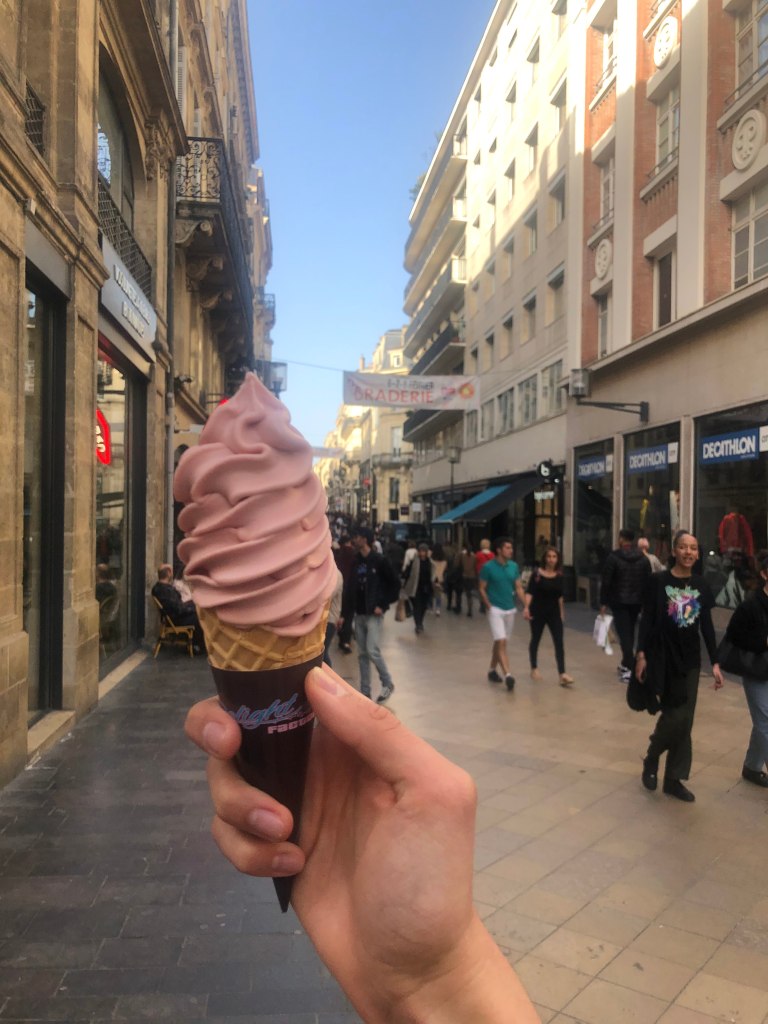
Glace dans la rue. 
 Matt en France